Bright Bar vs Black Bar: Which Finish Do You Actually Need?
Bright bar vs black bar is one of the most common questions buyers...
Read More →
A wrong supplier decision rarely shows up on day one. It shows up three weeks later, when a batch fails a grade check, a mill test certificate doesn’t match the material on the truck, or a “bulk order” turns out to be beyond what the supplier can actually dispatch on time. For procurement teams, engineers, and buyers, how to choose the right stainless steel supplier in India isn’t a question of who quotes the lowest price – it’s a question of who you can trust with your production schedule.
Inconsistent grades, missing documentation, dimensional variance, and delayed dispatch all carry real costs: rework, downtime, and procurement effort that eats into whatever you saved on price. This guide walks through exactly what to check before you commit to a supplier, especially for bulk requirements.
Your supplier choice affects far more than the invoice. It directly influences:
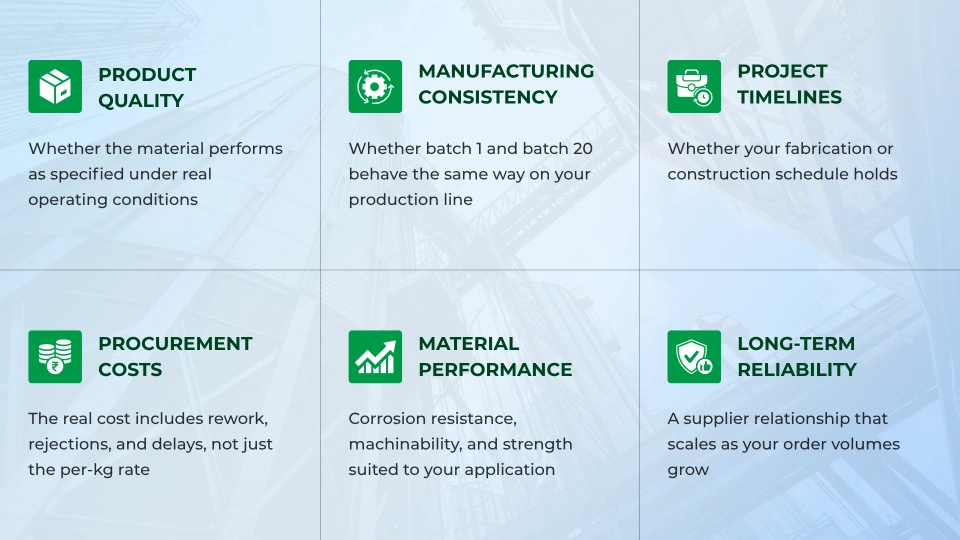
For industrial buyers, this isn’t a one-time transaction decision. It’s closer to selecting a manufacturing partner.
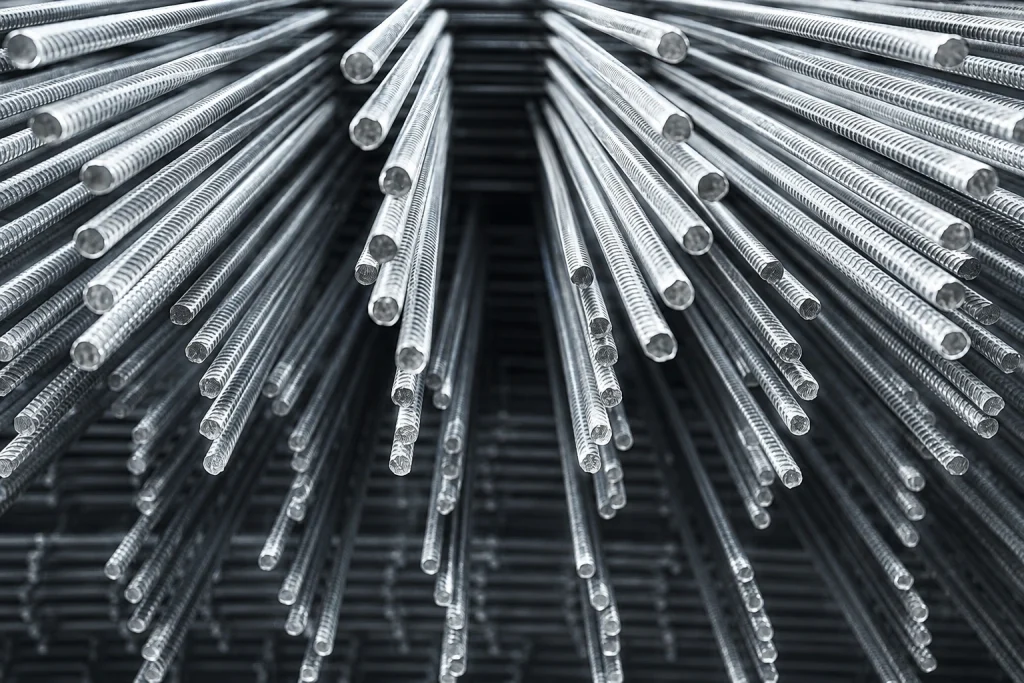
Start with the basics: does the supplier actually stock what you need, in the form you need it? Check whether they offer your required grade, shape (round, square, hexagonal, flat, or wire rod), size, and finish.
Common grades used industrially include 304, 316, 410, and 420 – each suited to different needs. Grade selection depends on your application: corrosion resistance, strength, temperature exposure, and fabrication method all factor in. No single grade is universally “better” – the right choice depends entirely on where and how the material will be used. A supplier who asks about your application before recommending a grade is generally more reliable than one who just pushes their most available stock.
Certifications are a fast way to separate documented, process-driven manufacturers from unverified traders. Ask about:
Don’t take claims at face value – request copies of certificates and verify they’re current before finalizing a large order.
A Mill Test Certificate (MTC) is a document that verifies key material properties for a specific batch, including grade, chemical composition, mechanical properties, and heat/batch traceability against applicable standards. For any serious industrial buyer, an MTC isn’t optional paperwork – it’s how you confirm that what’s written on the order matches what’s actually in the delivery. Ask your supplier whether MTCs are issued for every batch, and whether they’re traceable back to the original mill.
Bulk stainless steel orders in India need more than available stock-Sthey need consistency across the whole order. When evaluating a supplier for large-volume purchases, check:
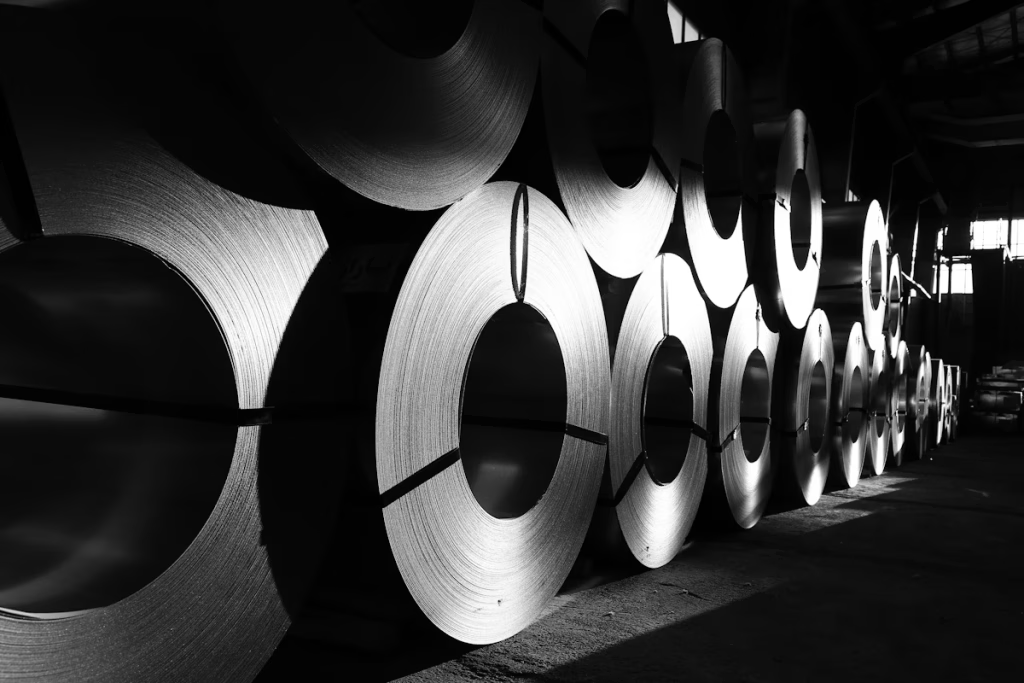
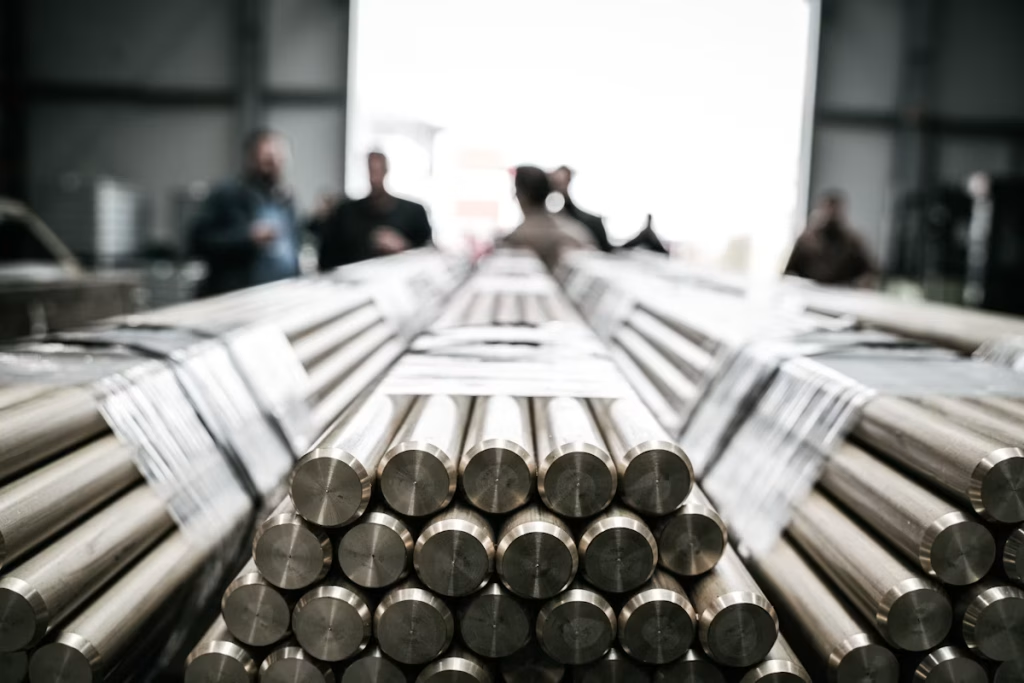
Bulk orders rarely arrive in standard catalog dimensions. Confirm whether the supplier can meet your required diameter, length, thickness, width, shape, tolerance, and finish. If your project needs cut-to-size stainless steel bars, ask specifically whether that’s offered in-house or outsourced, since that affects both lead time and cost. Suppliers who handle custom sizing internally typically offer tighter tolerance control.
Requesting a stainless steel bar sample before a bulk order lets you verify dimensions, surface condition, grade documentation, and suitability for your application before committing to volume. Not every supplier offers free samples, but most credible ones will provide material for inspection on request. If a supplier is reluctant to send a sample or share documentation upfront, treat that as a signal worth investigating further.
Experience with your specific industry matters. A stainless steel supplier for the construction and automotive industry already understands common tolerance requirements, typical failure points, and preferred grades for those applications – which usually means fewer clarification cycles and faster turnaround. Ask whether the supplier has relevant experience in your sector: construction, automotive, chemical, oil & gas, petrochemical, power, cement, engineering, or manufacturing.
Finally, evaluate the practical side of the relationship: delivery reliability, packaging standards, logistics coordination, and communication quality. If you’re sourcing internationally, ask specifically about their experience as a stainless steel export supplier from India – export documentation, customs handling, and shipping coordination are a different skill set from domestic dispatch, and not every supplier handles both equally well.
| Factor | What to Check |
| Product range | Grades, shapes, and sizes available |
| Quality | Specifications and quality-control processes |
| Certification | ISO 9001:2015 and relevant standards |
| Documentation | MTC issuance and traceability |
| Bulk capacity | Ability to maintain consistency across full order volume |
| Custom requirements | Cut-to-size, tolerances, and finishes |
| Delivery | Lead time and logistics reliability |
| Industry experience | Relevant application and sector knowledge |
| Export capability | Documentation and shipping support |
| Communication | Responsiveness during enquiry and order stages |
A low quoted price and low overall procurement cost are not the same thing. Material that’s the wrong grade, poorly documented, or dimensionally inconsistent can lead to rework, production delays, outright rejection at your quality check, replacement costs, and downtime – all of which erode whatever you saved on the initial rate. When comparing quotes, weigh certification, documentation, and consistency alongside price, not instead of it.
Star Steels Co. has supplied stainless steel bars and wire rods since 1985, offering Round Bars, Square Bars, Hexagonal Bars, Flat Bars, and Wire Rods in grades 304, 304L, 316, 316L, 410, and 420. We hold ISO 9001:2015 certification, along with GST and UDYAM registration, and offer cut-to-size services with bright, black, or polished finishes. Samples are available for inspection before bulk confirmation.
As a leading stainless steel bars & rod supplier in India, we work with construction, automotive, chemical, oil & gas, petrochemical, power, and cement industries, supplying both domestically and internationally. You can review our stainless steel round bars, square bars, hexagonal bars, flat bars, and wire rods, or explore our product knowledge and technical information resources for grade-specific guidance.
Choose a supplier based on grade range, ISO 9001:2015 certification, MTC documentation, bulk-order capacity, and delivery track record. Verify with samples before ordering.
A Mill Test Certificate (MTC) is a document confirming a steel batch’s grade, composition, and mechanical properties, verified against standards for traceability.
Grades 304, 316, 410, and 420 are most common in industrial use, chosen based on corrosion resistance, strength, and application needs.
In Summary
Choosing a stainless steel supplier comes down to five things working together: quality, grade accuracy, documentation, certification, bulk capability, and delivery reliability. Price matters, but only after these fundamentals are confirmed.
Have a bulk stainless steel requirement to plan? Get in touch with Star Steels Co. with your grade, size, and quantity specs, and we’ll walk you through availability and timelines.