Stainless Steel Bar Manufacturing Process Explained
Every stainless steel bar on your shop floor went through a dozen steps...
Read More →
Bright bar vs black bar is one of the most common questions buyers ask when two stainless steel bar quotes arrive with identical grades and sizes but different prices. More often than not, the difference is finish, and most buyers never stop to ask why one costs more or which one their application actually calls for.
Finish isn’t just about how a bar looks. It affects machinability, how much secondary processing you’ll need, and in some cases, how the material performs once it’s in use. Here’s what separates bright bar from black bar, and how to know which one you should actually be ordering.
Picking a finish isn’t just a cosmetic decision. It affects:
Getting this wrong doesn’t usually break a project, but it often means paying for processing you didn’t need, or under-speccing a bar for an application where finish actually mattered.
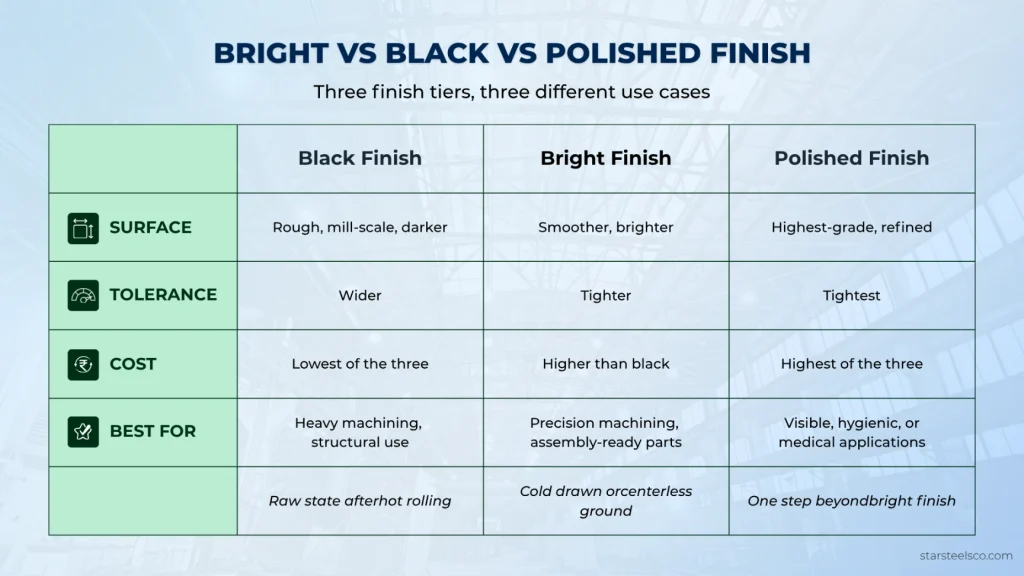
Black finish refers to the bar’s condition right after hot rolling, before any further surface treatment. It carries a rougher, darker, mill-scale surface – the raw state the material comes in once it’s been shaped but not yet refined.
Black finish bars are:
If your application involves heavy machining, structural use, or the bar will be significantly reshaped before final use, black finish is frequently the practical, economical choice.
Bright finish is achieved through cold drawing or centerless grinding after the initial hot rolling stage. This process removes the mill scale and tightens the bar’s dimensional tolerance, leaving a smoother, brighter surface.
Bright finish bars typically offer:
Bright finish costs more than black finish, but that cost often pays for itself in reduced secondary processing and better dimensional reliability.
Worth mentioning alongside these two: polished finish goes a step further than bright, refining the surface even more for applications where appearance or hygiene standards matter – visible fittings, food-grade equipment, or medical components, for example. It’s a separate tier above bright, not a substitute for the bright-vs-black decision most buyers are actually weighing.
| Factor | Black Finish | Bright Finish |
| Surface | Rougher, mill-scale, darker | Smoother, brighter |
| Dimensional tolerance | Wider | Tighter |
| Typical cost | Lower | Higher |
| Best suited for | Heavy machining, structural use | Precision machining, assembly-ready parts |
| Secondary processing needed | Often more | Often less |
A few questions can settle this quickly:
Will the bar be heavily machined before use? If most of the outer surface is getting removed anyway, black finish often makes more sense – you’re paying for a refined surface you’re about to cut away.
Do you need tight tolerances out of the box? If the bar goes straight into precision assembly with minimal further work, bright finish is usually worth the extra cost. Cold drawn and ground bars are produced to tighter tolerance classes than hot rolled bars, as defined in standards such as those published by ASTM International.
Does appearance or surface cleanliness matter for the end use? If yes, look at bright or polished rather than black.
What’s the actual cost difference for your order size? On small orders, the price gap may be negligible. On bulk orders, it can meaningfully affect your total procurement cost – worth confirming both quotes before deciding.
At Star Steels Co., finish is one of the specs we get asked about most – and for good reason, since it genuinely changes what a bar is ready for. We supply Round Bars, Square Bars, Hexagonal Bars, and Flat Bars in bright, black, and polished finishes, across grades 304, 304L, 316, 316L, 410, and 420, with cut-to-size services available for orders that need custom dimensions alongside the right surface condition.
If you’re not sure which finish fits your application, our team can walk you through it based on your drawing or end use – reach out through our contact page, or browse our product knowledge resources for grade and spec details.
Black finish is the bar’s raw, mill-processed state after hot rolling, with a rougher surface and wider tolerance. Bright finish is achieved through cold drawing or grinding afterward, giving a smoother surface and tighter dimensional tolerance.
Not necessarily – it depends on your application. If the bar will be heavily machined anyway, black finish is often more cost-effective. Bright finish is worth the extra cost when you need tight tolerances or minimal further processing.
Black finish skips the additional cold drawing or grinding step that bright finish requires, so it involves less processing time and cost, which is reflected in the price.
The Bright bar and black bar choice isn’t just a style style decision – It reflects real differences in surface condition, tolerance, and cost that affect how ready a bar is for your specific use. Matching the finish to your actual application, rather than defaulting to whichever is cheaper or more familiar, is what keeps you from paying for processing you don’t need or under-speccing a part that needed tighter tolerances.
Not sure which finish your project needs? Contact Star Steels Co. – our team can help you match the right finish to your application before you order.