Bright Bar vs Black Bar: Which Finish Do You Actually Need?
Bright bar vs black bar is one of the most common questions buyers...
Read More →
Every stainless steel bar on your shop floor went through a dozen steps before it ever reached your order. Melted, cast, rolled, annealed, pickled, drawn, straightened, and cut – each stage shapes not just the bar’s dimensions, but its strength, finish, and how it’ll behave once it’s welded, machined, or put under load.
Most buyers never see this process, but understanding it makes a real difference. This Stainless Steel Bar Manufacturing Process Explained covers why one bar costs more than another, why a mill test certificate matters, and why “the same grade” from two suppliers can still perform differently, from raw material to finished product.
You don’t need to run a mill to benefit from knowing this. Understanding the manufacturing process helps you:
With that in mind, here’s the process broken down stage by stage.
The process starts in an electric arc furnace, where raw materials – scrap steel, iron, chromium, nickel, and other alloying elements – are melted together. The exact mix of elements at this stage is what determines the grade: chromium content drives corrosion resistance, while nickel affects strength and formability. This is where a bar destined to be 304 starts differing from one destined to be 410, long before it takes any physical shape.
Once melted, the molten steel is cast into semi-finished shapes called billets – long, roughly square cross-sections that will later be worked into bars. Continuous casting is the most common method, where molten metal is poured into a mold and gradually solidified into a continuous strand, then cut into billet lengths.
The billet is reheated and passed through a series of rollers that gradually reduce its cross-section while stretching its length – this is hot rolling. It’s done at high temperature, which makes the steel more workable and helps break down the coarse internal grain structure from casting into something more uniform. At this stage, the bar starts taking on its rough shape – round, square, flat, or hexagonal – though it’s still far from finished dimensions.
After hot rolling, the bar undergoes annealing – a controlled heating and cooling process that relieves internal stress and restores the steel’s mechanical properties after the rolling process. Annealing is critical for consistency: it’s part of what ensures one length of bar behaves the same way as the next.
Hot rolling and annealing leave a layer of oxide scale on the bar’s surface. Pickling – typically an acid bath – removes this scale and reveals a clean surface underneath. This step is also where the groundwork for the bar’s final finish gets laid; a properly pickled surface is easier to polish or bright-finish later.
For bars that need tighter tolerances, a smoother surface, or higher strength, the material goes through cold working – drawing it through a die (for round bars) or rolling it (for flats and other shapes) at room temperature. This step is where a lot of the dimensional precision buyers actually need gets built in, and it’s often what separates a standard bar from one suited for precision machining.
Bars can pick up slight bends or curves during rolling and drawing. A straightening process – typically rotary straightening for round bars – corrects this, so the finished product meets straightness tolerances required for machining, welding, or structural use.
Bars are cut to standard stock lengths, or to custom lengths for cut-to-size orders. This is also where batch tracking usually gets tied to specific lengths, so material stays traceable back to its Mill Test Certificate even after cutting.
The final surface treatment is applied here – bright, black, or polished, depending on the specification. This step affects both appearance and how much (if any) secondary processing the buyer will need to do before using the material.
Before dispatch, samples from each batch are tested for chemical composition, mechanical properties, and dimensional accuracy against the relevant standards. This is where the Mill Test Certificate is generated – the document that lets a buyer verify the batch actually meets the grade and specification it was ordered as.
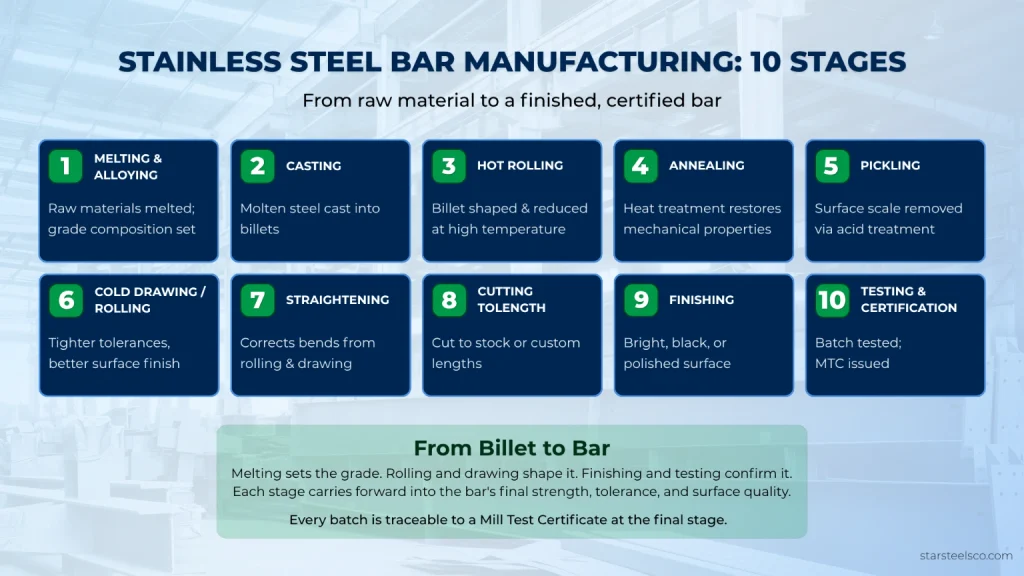
| Stage | What Happens |
| Melting & Alloying | Raw materials melted; grade composition set |
| Casting | Molten steel cast into billets |
| Hot Rolling | Billet shaped and reduced at high temperature |
| Annealing | Heat treatment restores mechanical properties |
| Pickling | Surface scale removed via acid treatment |
| Cold Drawing/Rolling | Tighter tolerances and improved surface achieved |
| Straightening | Corrects bends from rolling and drawing |
| Cutting | Bars cut to stock or custom lengths |
| Finishing | Bright, black, or polished surface applied |
| Testing & Certification | Batch tested; Mill Test Certificate issued |
Not every supplier runs every one of these steps in-house, and that’s not automatically a red flag – many reliable suppliers focus on specific stages and source semi-finished material from established mills. What matters is traceability: can they tell you where the raw material came from, and can they back every batch with a Mill Test Certificate that reflects actual testing, not a generic document? A supplier who understands and can explain their own process is usually one worth trusting with a bulk order.
At Star Steels Co., we’ve been working with stainless steel bars and wire rods since 1985 – long enough to know that consistency comes from respecting every stage of this process, not skipping the ones that are hard to see. Our Round Bars, Square Bars, Hexagonal Bars, Flat Bars, and Wire Rods are supplied across grades 304, 304L, 316, 316L, 410, and 420, with bright, black, and polished finish options and cut-to-size services available.
We’re ISO 9001:2015 certified, GST and UDYAM registered, and every batch we supply is backed by a Mill Test Certificate you can actually verify. For more on how grade and finish choices affect your application, our product knowledge and technical information pages go into further detail.
Black finish is the bar’s raw, mill-processed state after hot rolling, with a rougher surface and wider tolerance. Bright finish is achieved through cold drawing or grinding afterward, giving a smoother surface and tighter dimensional tolerance.
Not necessarily – it depends on your application. If the bar will be heavily machined anyway, black finish is often more cost-effective. Bright finish is worth the extra cost when you need tight tolerances or minimal further processing.
Black finish skips the additional cold drawing or grinding step that bright finish requires, so it involves less processing time and cost, which is reflected in the price.
A stainless steel bar goes through ten distinct stages before it’s ready to ship – each one shaping its grade, strength, tolerance, and finish. Understanding this process gives buyers a real basis for comparing suppliers, beyond just price and delivery time.
Have questions about how a specific grade or finish is produced? Contact Star Steels Co. – our team can walk you through the process behind your order.