Bright Bar vs Black Bar: Which Finish Do You Actually Need?
Bright bar vs black bar is one of the most common questions buyers...
Read More →
A quote lands in your inbox with terms like “MTC,” “tolerance class,” and “bright finish,” and suddenly a simple purchase decision feels like it needs a technical dictionary. Misread even one of these terms, and you could end up ordering the wrong grade, missing a tolerance requirement, or approving a spec that doesn’t actually fit your application.
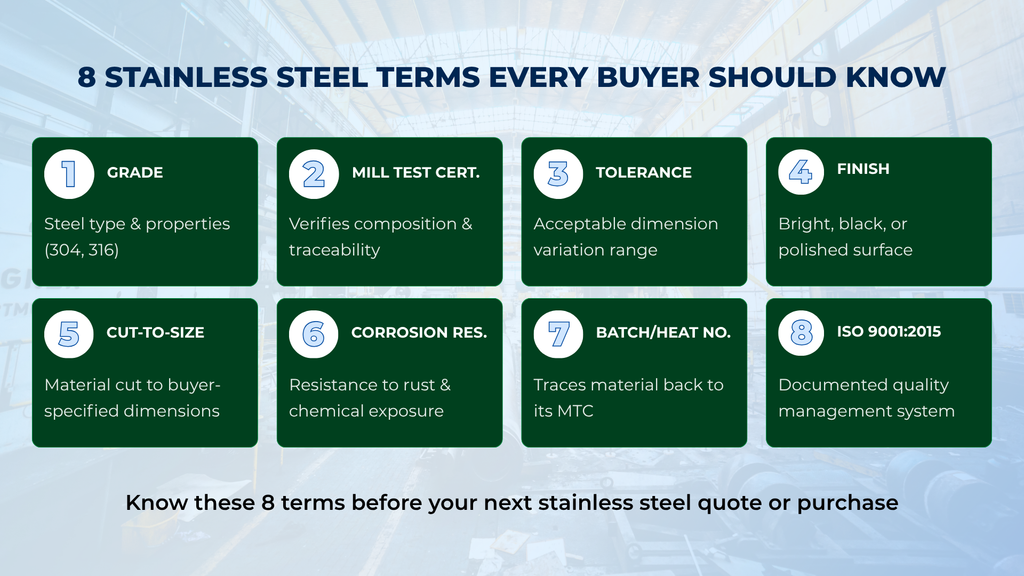
You don’t need to be a metallurgist to buy stainless steel correctly. Below are the 8 Essential Stainless Steel Terms Every Buyer Should Know well enough to read a quote, a spec sheet, or a Mill Test Certificate with confidence – and to ask the right questions before you order.
Most procurement and engineering teams don’t come from a materials background, and suppliers don’t always explain their documentation in plain language. That’s exactly where mistakes creep in: the wrong grade gets signed off, a tolerance requirement slips through, or a finish that doesn’t suit the application gets ordered because nobody double-checked. Knowing these terms closes that gap, so you’re evaluating your order instead of just trusting it.
Grade identifies the specific type of stainless steel and its composition – think 304, 316, 410, or 420. Each one offers a different level of corrosion resistance, strength, and suitability for heat or chemical exposure. It’s the single most important spec on any order, because it decides how the material will actually hold up once it’s in use.
A Mill Test Certificate is issued for a specific batch of material and verifies its grade, chemical composition, mechanical properties, and heat/batch traceability against the relevant standards. In short, it’s your proof that what’s written on the order matches what’s actually arriving. Always check the MTC lines up with the exact batch you’re receiving – not a generic reference sheet the supplier reuses.
Tolerance is how much a bar’s dimensions – diameter, length, thickness, or width – are allowed to vary from the stated size. Tighter tolerances mean less room for deviation and are usually required when material goes straight into machining or precision assembly. Wider tolerances are typically fine for general fabrication work. Either way, confirm the tolerance class matches what your application actually needs before you place the order.
Finish describes the surface condition of the bar. The three you’ll come across most often:
Finish shapes both how the material looks and how much extra processing it’ll need before you can use it.
Cut-to-size means the material arrives cut to your exact dimensions instead of a standard stock length. It saves you the hassle of secondary cutting and keeps dimensions consistent across the whole order. Worth asking whether cutting happens in-house or gets outsourced – in-house cutting usually means tighter tolerance control.
Corrosion resistance is how well a grade holds up against rust and degradation from moisture, chemicals, or general environmental exposure. It’s a big part of why buyers choose stainless steel in the first place – but resistance isn’t uniform across grades. A grade that’s perfectly fine for general use might not survive a chemical processing environment.
A batch number (sometimes called a heat number) identifies a specific production run of material. It’s what ties a bar back to its Mill Test Certificate, so you can confirm consistency across an order. On bulk orders especially, it’s worth checking whether batch numbers stay consistent – and if they don’t, understanding why matters for quality assurance.
ISO 9001:2015 is an international standard for quality management systems. A supplier holding this certification has a documented, audited process behind their production. It won’t guarantee every single batch is flawless, but it does tell you there’s a structured quality process in place – and that’s worth verifying before a large order goes out.
| Term | What It Means |
| Grade | Identifies the steel type and its properties (e.g., 304, 316) |
| Mill Test Certificate (MTC) | Batch-specific document verifying composition and traceability |
| Tolerance | Acceptable dimensional variation from the stated size |
| Finish | Surface condition – bright, black, or polished |
| Cut-to-Size | Material cut to buyer-specified dimensions |
| Corrosion Resistance | How well the grade withstands rust and chemical exposure |
| Batch/Heat Number | Identifier used to trace material back to its MTC |
| ISO 9001:2015 | Certification confirming a documented quality management system |
Once these terms make sense to you, comparing quotes gets a lot easier. Instead of taking a supplier’s word for it, you can ask specific questions: “What’s the tolerance class on this batch?” or “Can I see the MTC before it ships?” That shift – from a general buyer to an informed one – is usually what stands between you and a costly mismatch between what you ordered and what actually shows up.
Star Steels Co. has supplied stainless steel bars and wire rods since 1985, offering Round Bars, Square Bars, Hexagonal Bars, Flat Bars, and Wire Rods in grades 304, 304L, 316, 316L, 410, and 420. We hold ISO 9001:2015 certification, along with GST and UDYAM registration, and provide cut-to-size services with bright, black, or polished finishes, backed by Mill Test Certificates for our batches.
For grade-specific guidance, you can also browse our product knowledge and technical information resources.
Grade is the most critical one – it determines the material’s corrosion resistance, strength, and suitability for your specific application. Every other spec builds on top of the correct grade selection.
It’s the acceptable range of dimensional variation from the stated size. Tighter tolerances are typically needed for precision machining, while wider tolerances work fine for general fabrication.
It verifies the actual grade, composition, and traceability of the specific batch you’re buying – confirming the delivered material matches what was ordered, rather than relying on a generic spec sheet.
Get comfortable with these eight terms – grade, MTC, tolerance, finish, cut-to-size, corrosion resistance, batch number, and ISO 9001:2015 – and a confusing quote turns into something you can actually evaluate. That’s what makes it easier to compare suppliers, catch mismatches early, and order with confidence.
Have questions about a stainless steel spec or quote? Contact Star Steels Co. – our team can walk you through the grade, tolerance, and documentation for your requirement.